Revue Faire #47/48 - Mechanical Translations
Critical publications dedicated to the analysis of Graphic Design are sadly few and far between today, particularly in France, but also in Europe as a whole. Adopting an analytical and critical posture with regard to the forms and activities of Graphic Design, Sacha Léopold and François Havegeer established in 2017 a printed publication that deals with these practices.
Special double issue:
n°47 — Machines, Accents, and Affects. Author: Camille Pageard
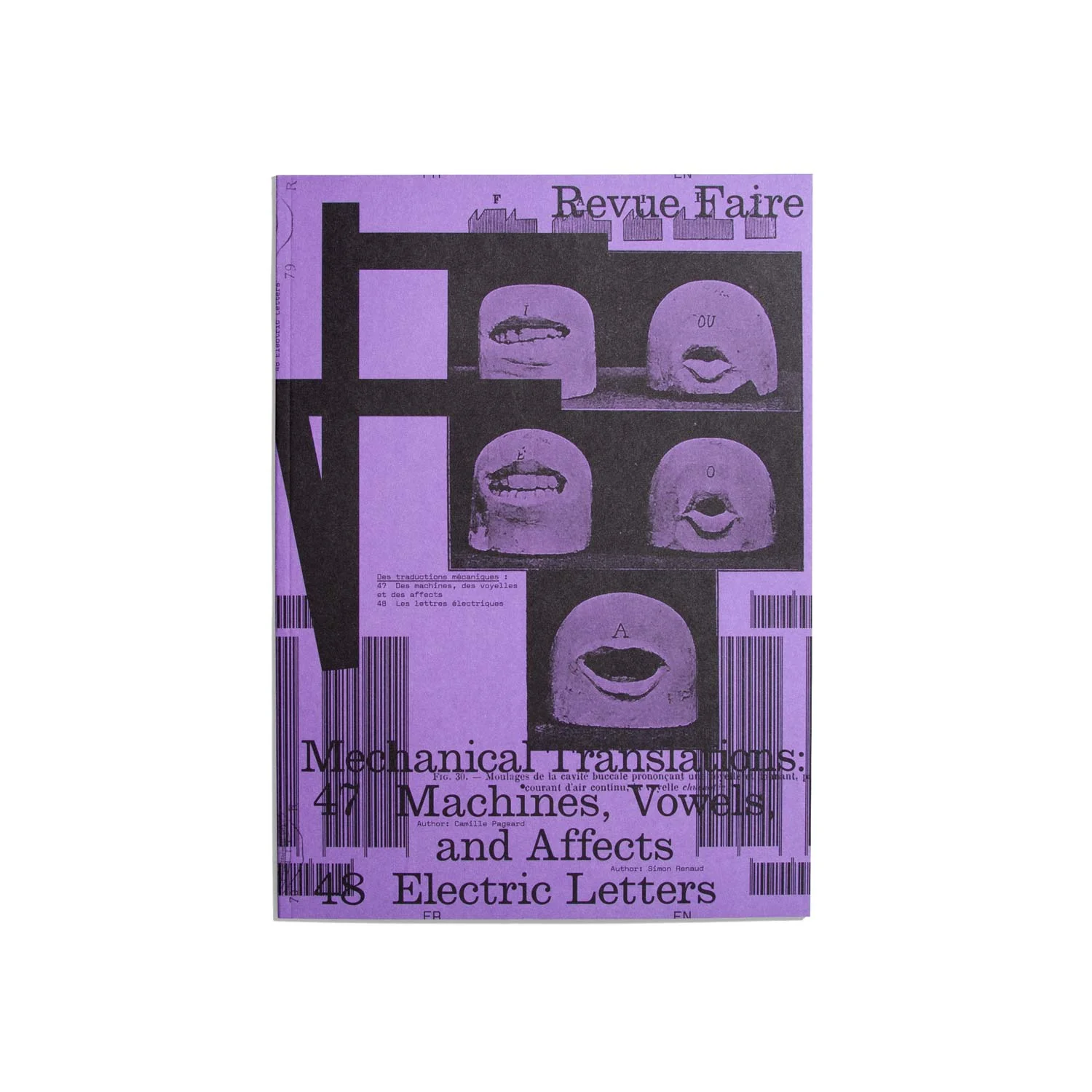
Built at the very end of the 19th century to study the physiology of the voice, Dr. Marage’s vowel machine sheds new light on the origins of sound measurement and the extensive field of writing the voice. Throughout the 20th century, the machine’s appearances in print were driven by a constant scientific curiosity for the mechanical reproduction of the voice along with an upheaval in affective relationships with machines. Coupled with the history of graphic inscription of the voice, it reveals a unique history of our attraction and repulsion to technical objects. Through its visual representations and mechanical and technological transfer, an “order of language” also emerges—a politics of language that continues to be exercised in contemporary forms of subjugation.
n°48 — Electric Letters. Author: Simon Renaud
To understand what digital computing does to writing, it is interesting to examine its origins: the treatment of binary code. This transformation of writing by machine and its emergence finds its roots in telegraphs and the advent of electricity in the 19th century. Mastery of this physical phenomenon converts our alphabet into new symbols drawn from electrical signals.
Our writings, initially addressed and interpreted by humans, are completed by a code that can be manipulated by the machine. Both of these worlds are intertwined so that a common code can exist. Each one uses the symbol that corresponds to it: the signal for machines and the sign for humans. This new code operates in the material dimension of the signals and is based on the presence or absence of an electrical current. This minimal activity establishes its form and, paradoxically, allows it to become completely detached from said form.
Produktinformationen
Produktinformationen
Versand & Rückgabe
Versand & Rückgabe
Revue Faire #47/48 - Mechanical Translations
Revue Faire #47/48 - Mechanical Translations
Critical publications dedicated to the analysis of Graphic Design are sadly few and far between today, particularly in France, but also in Europe as a whole. Adopting an analytical and critical posture with regard to the forms and activities of Graphic Design, Sacha Léopold and François Havegeer established in 2017 a printed publication that deals with these practices.
Special double issue:
n°47 — Machines, Accents, and Affects. Author: Camille Pageard
Built at the very end of the 19th century to study the physiology of the voice, Dr. Marage’s vowel machine sheds new light on the origins of sound measurement and the extensive field of writing the voice. Throughout the 20th century, the machine’s appearances in print were driven by a constant scientific curiosity for the mechanical reproduction of the voice along with an upheaval in affective relationships with machines. Coupled with the history of graphic inscription of the voice, it reveals a unique history of our attraction and repulsion to technical objects. Through its visual representations and mechanical and technological transfer, an “order of language” also emerges—a politics of language that continues to be exercised in contemporary forms of subjugation.
n°48 — Electric Letters. Author: Simon Renaud
To understand what digital computing does to writing, it is interesting to examine its origins: the treatment of binary code. This transformation of writing by machine and its emergence finds its roots in telegraphs and the advent of electricity in the 19th century. Mastery of this physical phenomenon converts our alphabet into new symbols drawn from electrical signals.
Our writings, initially addressed and interpreted by humans, are completed by a code that can be manipulated by the machine. Both of these worlds are intertwined so that a common code can exist. Each one uses the symbol that corresponds to it: the signal for machines and the sign for humans. This new code operates in the material dimension of the signals and is based on the presence or absence of an electrical current. This minimal activity establishes its form and, paradoxically, allows it to become completely detached from said form.
Produktinformationen
Produktinformationen
Versand & Rückgabe
Versand & Rückgabe
Description
Critical publications dedicated to the analysis of Graphic Design are sadly few and far between today, particularly in France, but also in Europe as a whole. Adopting an analytical and critical posture with regard to the forms and activities of Graphic Design, Sacha Léopold and François Havegeer established in 2017 a printed publication that deals with these practices.
Special double issue:
n°47 — Machines, Accents, and Affects. Author: Camille Pageard
Built at the very end of the 19th century to study the physiology of the voice, Dr. Marage’s vowel machine sheds new light on the origins of sound measurement and the extensive field of writing the voice. Throughout the 20th century, the machine’s appearances in print were driven by a constant scientific curiosity for the mechanical reproduction of the voice along with an upheaval in affective relationships with machines. Coupled with the history of graphic inscription of the voice, it reveals a unique history of our attraction and repulsion to technical objects. Through its visual representations and mechanical and technological transfer, an “order of language” also emerges—a politics of language that continues to be exercised in contemporary forms of subjugation.
n°48 — Electric Letters. Author: Simon Renaud
To understand what digital computing does to writing, it is interesting to examine its origins: the treatment of binary code. This transformation of writing by machine and its emergence finds its roots in telegraphs and the advent of electricity in the 19th century. Mastery of this physical phenomenon converts our alphabet into new symbols drawn from electrical signals.
Our writings, initially addressed and interpreted by humans, are completed by a code that can be manipulated by the machine. Both of these worlds are intertwined so that a common code can exist. Each one uses the symbol that corresponds to it: the signal for machines and the sign for humans. This new code operates in the material dimension of the signals and is based on the presence or absence of an electrical current. This minimal activity establishes its form and, paradoxically, allows it to become completely detached from said form.